Sunday, August 21, 2011
graffiti... is an art ? (100) pics
Sunday, May 1, 2011
NASA launches space shuttle Endeavour's final flight image
Commissioned in 1987 to replace the space shuttle Challenger, which was lost in 1986, and named by elementary school students after the British HMS Endeavour, the sailing ship that took Captain James Cook on his first travels, the space shuttle Endeavour has earned a short but noteworthy place in NASA's history of space exploration.
The youngest of NASA's shuttle fleet, Endeavour was built with unique upgrades from previous orbiters, including the drag parachute used on landing; modified electrical and plumbing systems in the Extended Duration Orbiter (EDO), to allow for extended stays on board (up to 28 days); more-advanced computers and navigation systems; a solid-state star tracker; and improved steering mechanisms.
As a tool of space innovation, Endeavour has contributed to projects that have had far-reaching impacts on the space program, including the major Hubble Space Telescope repairs that improved Hubble's clarity, and 10 dockings with the International Space Station, during which Endeavour delivered and installed major sections of the international space outpost. This week will see the launch of mission STS-134, Endeavour's 25th and final flight, and the second-to-last space shuttle mission ever.
In this photo, Endeavour is seen on February 9, 2010, over the South Pacific Ocean off the coast of Southern Chile, at an altitude of 183 miles. The craft is silhouetted against the Earth as it prepares to dock with the International Space Station.
The orange troposphere, where all of the clouds we see from Earth are generated and contained, gives way to the whitish stratosphere and then to the mesosphere.
Monday, November 8, 2010
Greece: Birthplace of the modern world?
BFR92R The Acropolis, Athens, Greece as it would have appeared in ancient times. Photograph: Classic Image/Alamy
E pluribus unum: "out of many – one". The one-time motto of the US reminds us that, much like most of the larger nation states today, ancient Greece was a mosaic of very different components: about 1,000 of them at any one time between c600BC and AD330. That is, there were a thousand or so separate, often radically self-differentiated political entities, most of which went by the title of polis, or citizen-state. Our term "Greece" is derived from the Romans' Latin name, Graecia, whereas the ancient Greeks spoke of Hellas – meaning sometimes the Aegean Greek heartland, at other times the entire, hypertrophied Hellenic world – and referred to themselves as "Hellenes".
In the foundational epics attributed to Homer, however, you won't find Greeks referred to as "Hellenes" but as "Achaeans", "Danaans", or "Argives". That was because the epics are set in a period before "Hellas" and "Hellenes" had become common currency – before, that is, the eighth century BC, when Greeks first started emigrating permanently from the Aegean basin and settling around the Mediterranean and Black Seas. By the time of Plato, around 400BC, Hellas stretched from the Pillars of Heracles (straits of Gibraltar) in the west to Phasis in Colchis (in modern Georgia) in the far east. Later, following the conquests of Alexander the Great, the pale of Hellenic settlement was extended even further eastwards, as far as Afghanistan and the Indus Valley of Pakistan.
Everyone who was not a Hellene by birth, language or culture was labelled a barbaros. Originally an onomatopoeic description of anyone who spoke a non-Greek, unintelligible language, barbaros came to acquire the pejorative connotations of "barbarous" and "barbaric". The Romans took the same sort of view of all non-Romans – excepting only Hellenes – which is how those emotive terms entered our own language.
United Greece
Alexander the Great fighting in the Battle of Issus, ca. 310 B.C., based on Roman Mosaic from the House of the Faun, Pompeii, Italy Photograph: © Bettmann/CORBIS
The transformational turning point came in the first decades of the fifth century BC, in the course of the epic conflict known from the Greek standpoint as the Persian Wars. The mighty Persian empire, the fastest growing and largest oriental empire yet, had threatened to swallow up mainland Greece as well as those Greeks who lived within the bounds of what the Persians considered their own sphere – Asia. But on the battlefields of Marathon, Salamis, Plataea and Mycale, a relative handful of Greek communities managed to unite long enough to repulse that threat – for ever, as it turned out. Indeed, Alexander turned the tables by conquering the old Persian empire and starting to create a new Helleno-Persian successor: oriental in its underlying administrative and symbolic structure, but Greek in unifying language and high culture.
Furthermore, the Greeks' unexpected victories over the Persians of 490 and 480-479BC unleashed an era of unparalleled cultural creativity – from Aeschylus's tragic drama Persians of 472BC to the mathematical genius of Archimedes. However, united though they were by religion and common social customs and by at least partly fictional self-images, these Greeks were very much not united by one of their major contributions to the sum of human achievement – politics.
Much of our everyday political language is of ancient Greek derivation: monarchy, tyranny, oligarchy, aristocracy, plutocracy, democracy – not to mention the word "politics" itself. Much of the rest is Latin-derived: constitution, republic, empire, among others. But the Latin for "democracy" was democratia, a loan-word, because actually the Romans didn't do democracy – at least not in the original ancient Greek sense of the term; and they recognised, as we all do or should, that in this sphere the Greeks had been the original pioneers.
However, the ancient Greeks' demokratia was hugely different not just in scale but in kind from any modern political system that claims the title of "democracy". That was partly because the fundamental ancient Greek political unit, the polis, was a strong community in a very exclusive sense: only adult male citizens could consider themselves politically entitled. Even then, the ancient Greeks typically ruled themselves directly, in that they did not select rulers to rule over and for them. Theirs were direct, participatory self-governments, whereas ours are notionally "representative".
But democracy, so far from being the ancient Greek norm, was at first a rare and rather fragile plant: only later did it become about as widely distributed as various forms of oligarchy. And only in a few cases – in Athens, above all – was it both deeply rooted and conspicuously radical. At all times and in all places it remained more or less controversial. And there was a good linguistic reason for this. Demokratia was a compound of demos and kratos. But whereas kratos unambiguously meant "grip" or "power", demos could be interpreted to mean either "people" (in a vague sense, as in Abraham Lincoln's famous words at Gettysburg: "government of the people, by the people, for the people") or very specifically "the masses": the poor majority of the enfranchised citizen body (which might range in size from as few as 500, as on the island-state of Melos in the Cyclades, to as many as the 50,000 citizens of democratic Athens).
So if you liked demokratia, it could mean People Power, but if you hated it – if, say, you were a member of the wealthy elite – then it could stand for the ancient Greek equivalent of Lenin's dictatorship of the proletariat.
By and large the Romans took the second view, which is why they went to great lengths to stamp it out within their empire – the eastern half of which was basically Greek – in the end with total success. It therefore took a great deal of effort and ingenuity in the 19th century to rehabilitate "democracy" as a viably positive term of political discourse – and even then only at the cost of draining it of the active, participatory, class-conscious dimension the Athenians had given it.
Worship and sacrifice
A popular proverb says that the ancient Greeks "had a word for it". But actually they didn't always. A conspicuous example is that they had no word for our "religion", which is taken from Latin. Our manifold and multifarious legacy from the ancient Greeks does not include their polytheistic religion – which was superseded and suppressed by various forms of Judaeo-Christianity and then Islam. These latter faiths are all based on the presumption of a single deity, and on privileged hierarchies of vocational officials who interpret their sacred texts and dogmas. The ancient Greeks' "things of the gods", on the other hand, needed no clergy, dogma or doctrine: formulaic rituals mattered above all.
It is easy for us today to be over-impressed by the standing remains of monumental temples such as those on the Acropolis of Athens or of Greek Acragas (Agrigento in Sicily), or by reports of now lost wonders such as the huge seated cult-statue of Zeus at Olympia, crafted by master sculptor Pheidias of Athens in the 430sBC. For most Greeks the object of their greatest devotion was an altar, whether domestic or public. The most characteristic act of religious worship was the performance of a sacrifice, such as a gift of olive oil, wine or grain, or the killing of a pig or chicken. These offerings symbolised both communion between the god or goddess and their mortal worshippers, as well as the unbridgeable gulf that separated the human from the super-human. Though the Greeks' gods and goddesses were represented in human shape, they were regarded rather as powers – immeasurably more powerful than puny mortals.
Myths
Another unique feature about the Greek deities was that they didn't have a hand in creating the world. In fact, they themselves were created only after a void state of chaos. We refer to these stories about the Greek gods' supernatural origins and functions as "myths". But for the Greeks a myth was a traditional tale that could have a purely secular, mortal content. Indeed, it was a prime marker of advanced intellectuals' sceptical, rational, critical outlook that "myth" came to be downgraded as a derogatory term meaning something like a romantic fiction. And it was a condition of the Greeks' achievements in philosophy and the natural sciences that they managed to reason without invoking mythology, conducting their ideas on the understanding that the natural and human worlds could in principle be explained without recourse to the hypothesis of supernatural intervention.
The Greek world's first paid-up intellectual was Thales of Miletus (on the Aegean seaboard of western Turkey today), who lived around 600BC. He not only fell down wells while contemplating the heavens (as all proper intellectuals should), but also predicted a total solar eclipse (here he was fortunate to be heir to the discoveries and records of Babylonians and Egyptians before him), thus robbing it of potential divine mystique, and once made a substantial profit by successfully predicting a bumper olive harvest. Thales and his followers had a particular interest in the kosmos: a non-human universe that was hypothetically ordered and orderly. The way to study it was through historia: empirical enquiry or research.
Science
The results they came up with were hardly what we would call scientific. That was left for the doctors of the school of medicine, founded by Hippocrates in the fifth century BC on the east Aegean island of Kos; and the astronomers attached to the museum and library of Alexandria in Egypt in the third century BC. The latter spawned intellectual giants such as Eratosthenes from Cyrene in today's Libya, who successfully measured the Earth's circumference to within a small margin of error.
Despite these giant steps, it is important to remember that most ordinary Greeks were not persuaded to adopt a rationalist, non-theistic world outlook, nor were they always tolerant of the eccentric intellectuals they harboured in their midst – especially not at times of great societal crisis such as the Peloponnesian War (431–404BC). A case in point was the trial and execution of Socrates at Athens, by a democratic jury of 501 mostly "ordinary" Athenian citizens, in 399BC.
Socrates was convicted of "introducing brand-new, publicly unrecognised divinities" without the Athenian people's say-so, and of "corrupting the young". Both charges carried particular weight in the fraught circumstances of 399BC: this was just a few years after the Athenians' total defeat in the Peloponnesian war by Sparta, an enemy that prided itself on its conservative traditionalism in all matters concerning the gods. That its oligarchic junta had done to death many hundreds of ordinary Athenians was still fresh in the memory. The trial of Socrates and its outcome should remind us that democratic Athens, despite being a relatively open society, was no liberal paradise of principled religious tolerance.
Economics
Socrates is the main participant in a fictional dialogue composed by the versatile Athenian historian Xenophon (c428-355BC), entitled (in Latin transliteration) Oeconomicus. Yet "economics" in our sense is not what the discourse is about, but rather the management of an oikos or "household".
The Greeks "did" economics, practically speaking, but they did not theorise it as we do. This was partly because they did not develop a suitable macro-economic technical vocabulary but also because, like their politics and religion, their economic realities were very different from those of a capitalist, let alone a globalised, economy. Most Greeks lived on and from the land. This is not to deny that local, regional and international trading networks could be crucially important, not least when the commodity being traded was a life-giving staple such as grain. But as much as 80% of the typical population of a typical polis were employed in peasant-style, non-market-oriented agriculture, working to satisfy needs rather than maximise profit.
Women and slaves
Detail from a pyxis showing a scene from the women's quarter, c450BC Photograph: British Musuem
Women, whose public valuation by men was often distressingly low, were economically crucial within the household, where they processed food, produced children and clothing, and managed the free or unfree workforce.
The modern Greek term for housewife, noikokyra ("lady of the household") had its ancient counterpart, especially in Sparta, where women vied not just to control but to own more than one household property. Elsewhere in Greece, women's property rights were severely limited. Indeed, it wouldn't have been uncommon for a wealthy Greek house-lord to think of his womenfolk as little better than the chattel slaves he owned. Ordinary Greeks, of course, might not have had the luxury of owning even a single slave, greatly desirable though that was thought to be.
Most slaves were individually and privately owned, having been bought on the market as commodities. But some slaves – such as the gaolers of Socrates – were public servants. At Athens, there was an exceptional concentration of slave worker personnel in the state-owned silver mines, who were economically vital: the product of their labours paid for Athens' navy and a wide variety of other public and political services.
In Sparta they managed their servile system very differently. Although there were some chattel-type (privately owned) slaves, the dominant form of servitude here was a kind of collective serfdom, known as helotage. And whereas most chattel slaves were dispossessed, non-Greek foreigners, the Helots were born into inherited bondage: this, perhaps, a final reminder of just how alien ancient Greece can be, for all its status as one of the fountainheads of western civilisation.
Paul Cartledge is AG Leventis Professor of Greek culture at Cambridge University and the author of several books, most recently Ancient Greece: A History in Eleven Cities (Oxford University Press)
Monday, August 23, 2010
History of the Internet
Via: MBA Online
The internet has helped everyone around the world gather information much more quickly, especially students enrolled in online classes. It’s amazing to know people from anywhere in the globe can get an MBA online without having to live next to a physical institution. So in honor of the internet, we’ve created the following infographic highlighting the major events in internet history
Wednesday, May 26, 2010
MEPs back Estonia's euro ambitions
Thursday, October 1, 2009
100 Greatest Discoveries - Astronomy
"We both step and do not step in the same rivers. We are and are not."
Heraclitus the Riddler
Wednesday, May 20, 2009
Are You Fake-ing orgasm !!
Things are not that complex in the wildlife. Driven by its mating instincts, a male animal will mount a female mammal with a clear-cut intention of generating offspring. The female of a species will feel no orgasm whatsoever – the anthropoids and pigs being the only exception to the rule.
Women keep pulling the wool over men’s eyes.
We still live in the good old patriarchal society no matter what we think of it or how civilized it may look to us. Ladies, you say you want the right to vote? Please take it. Do you want to climb up the ranks as fast as men do? You are free to give it a try. Does the service take your fancy? Okay, go and enlist if you believe you are up the job. However, giving birth to children has been, is and will be a woman’s key job. Therefore, dear ladies, please bear in mind that sexual intercourse is something you cannot avert. Whether you get any “heavenly pleasure” out of lovemaking is an issue of secondary importance. Needless to say, taking pleasure in sex is better than having sex without any pleasurable sensations. At times women can pretend getting pleasure out of sex even if they feel nothing in the process.
Several reasons behind the inability of women to achieve orgasm
Want of skill
We are talking about a lack of experience on the part of one or both partners involved in sexual activity. You know, it takes two to tango. So it is either he who cannot bring her to the “top,” or it is she who cannot play along. The problem usually solves itself as partners grow older and a more mature in terms of issues related to sex. Until that happens, a girl will roll her eyes, she will moan while tossing about the bed “just like in a movie.” And she will certainly say “yes” when he asks her: “Honey, did you cum?”
Sexual incompatibility
Sexual incompatibility happens here and there ever and anon. It is nothing to worry about if partners have just started sleeping with each other and their phase of searching for mutual sexual preferences is still on. By faking orgasm a woman can show her love and affection to her partner. But things grow more complex if the incompatibility of calibers, shall we put it mildly, comes into play. A woman will disguise her real pain as orgasmic moans of wild passion if her partner’s penis is far too large for her to handle. She is likely to pretend having a “journey to the Moon and back” just to make him come as soon as possible. On the other hand, a man whose love muscle is rather small simply cannot bring his partner to orgasm if the couple practices a missionary position. Yet smallness is not a good reason for hurting a good man’s feelings.
Health problems
Health problems preventing women from getting the joy of sex are aplenty. Anything can turn a pleasurable experience into a torture. A case of cystitis is one of the most frequent examples.
Orgasm is an issue for which a woman cannot care less if she feels a sharp pain or intense burning in her vagina during penetration. Dysmenorrhoea or painful menstruation can also make a mockery of pleasure when it comes to sex in disregard of hygienic preconceptions.
Mood swings
Woman is human too. She can feel lousy too due to a wide variety of reasons including a broken fingernail or an oaf who stepped on her foot in a crammed bus. The right mood for a woman in search of orgasm is of key importance because female orgasm is more psychological and less physiological in nature by comparison to the male one.
Job to do
Have you ever thought about the way porn movies are shot? We are not talking about homemade videos “for your eyes only,” when you try to do some sex acrobatics for the benefit of your video camera positioned on a night table. We mean pornographic motion pictures made for commercial purposes. Well, here is a couple of things for your information. In fact, all those movies, be it a short video or a full-length film, are made in accordance with the standard rules of filmmaking i.e. numerous takes, various positions, close-ups and backgrounds are subject to change in line with a plot while cameramen, stagehands and sound engineers run around in an endless flurry of activity. In other words, what kind of orgasm are we talking at the end of an 8-hour shift on the set full of light and strangers bound by their contractual obligations?
Men cannot be trusted
According to statistics, from 20 to 25% of men have feigned orgasm at least once in their life. How on earth can it happen? Nice and easy, in the dark, under the blanket, and with your condom on. “Keep the lights off, will you? I gotta take a shower but I’ll be back in a minute…” You can get away with it even if you deal with an experienced woman provided that you are a good actor. Your acting does the trick especially at the beginning of a relationship Taosists, the followers of Taosism, a philosophical system developed by Lao-tzu and Chuang-tzu, are reportedly capable of ejaculating into their own bladders. They somehow manage to direct the flow of semen inward so nothing pours out outward. The technique is very good for energy conservation yet highly detrimental for male health. What if a Taosist should feel like having children? Redirecting semen would be a tough job to do.
Several reasons behind the inability of men to achieve orgasm
Lack of experience
Inexperience is likely to bring about a lack of orgasm in both partners if a boy has sex for the first time with a girl who knows next to nothing about sexual techniques. Both of them will be the casualties of the same misfortune, so to speak.
Lack of desire
Not unlike woman, man can be very sensitive and vulnerable. It is very unlikely that he will be able to think about football and come to orgasm while making love to a woman he does not fancy. That is why “madams” normally show off their girls in a brothel or at the roadside. No man will sleep with a woman who is ugly as sin. Well, maybe some fellow will – provided he is fresh from prison after serving his 15-year term.
Job-related stress
Contrary to a popular belief, men do not feel the hots at all times. All of us live in a stressful world that knows no repose. Sometimes there is no way a man can stop thinking of his urgent work problems after one hell of a day in the office. “Nothing personal, I’ve got more important things on my mind at the moment.”
Health problems
Some men cannot achieve orgasm because they have too much of a drink. It could be worse. It is actually much worse since half of Russian men above 40 have problems with their prostates due to a number of reasons including hypodynamia, STDs, drunkenness, and irregular sex life. In short, men themselves are to blame.
In conclusion
There is one more reason why a woman can fake orgasm. She wants her partner to get off and feel like a full-blown man, not like some freak of nature. Conception is still possible no matter if a woman fakes it or not, provided that her reproductive organs are in order. After all, all living creatures are programmed to procreate. On the other hand, a man feigns orgasm for entirely egotistic purposes. He is either keen to look good in the eyes of his lady or he wants her to leave him alone.
"We both step and do not step in the same rivers. We are and are not."
Heraclitus the Riddler
Saturday, May 16, 2009
Atlantis the lost land
'In all things of nature there is something of the marvelous',
Aristotle, Part of animals.Atlantida presents an imaginary journey through the seven islands experienced as an interchange between image and sound charting a conversational movements of colour, light, texture through the natural world.
From Wikipedia, the free encyclopedia
"We both step and do not step in the same rivers. We are and are not."
Heraclitus the Riddler
Sunday, April 26, 2009
all we are saying...
Give Peace A Chance Lyrics
Artist(Band):John Lennon
two, one two three four
Ev'rybody's talking about
Bagism, Madism, Dragism, Shagism, Ragism, Tagism
This-ism, that-ism
ism ism ism
All we are saying is give peace a chance
its goin' great
Everybody's talkin' bout'ministers,
sinisters, banisters and canisters,
bishops and fishops and rabbis and pop eyes,
and byebye, byebyes
all we are saying is give peace a chance,
let me tell you now
Ev'rybody's talking about
Revolution, evolution, masturbation,
flagellation, regulation, integrations,
meditations, United Nations,
Congratulations.
All we are saying [keep talking] is give peace a chance
All we are saying is give peace a chance
Oh Let’s stick to it
Ev'rybody's talking about
John and Yoko, Timmy Leary, Rosemary, Tommy smothers, Bobby Dylan,
Tommy Cooper, Derek Tayor, Norman Mailer, Allen Ginsberg, Hare Krishna,
Hare Hare Krishna
All we are saying is give peace a chance
"We both step and do not step in the same rivers. We are and are not."
Heraclitus the Riddler
Thursday, April 23, 2009
A political one
is communism a fallen era?
"We both step and do not step in the same rivers. We are and are not."
Heraclitus the Riddler
Wednesday, March 18, 2009
Freemasonry in Greece: Secret History Revealed
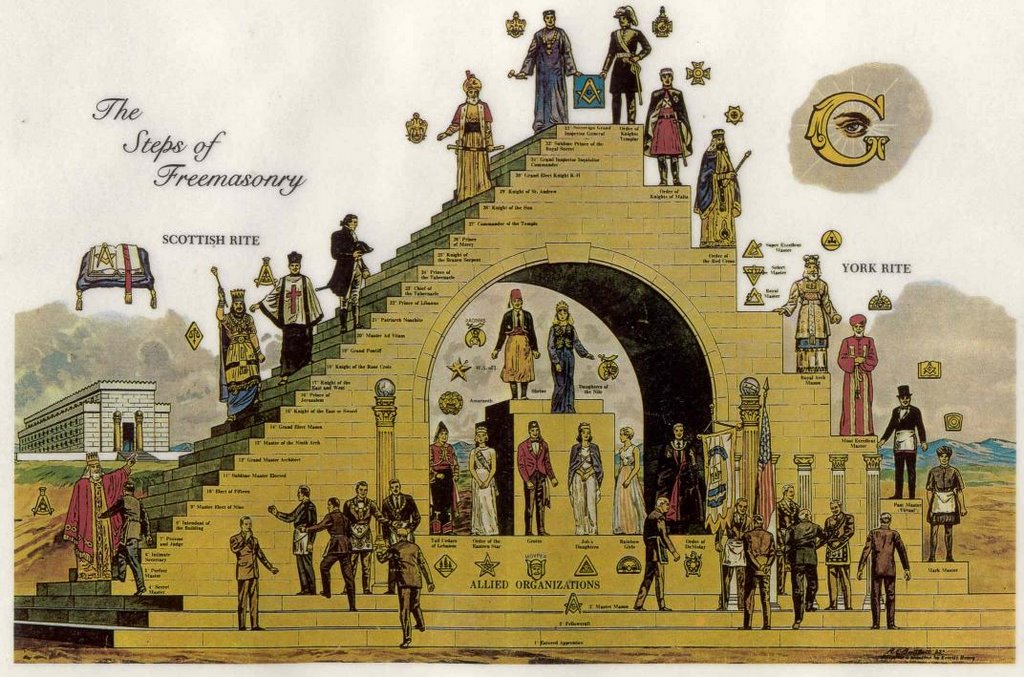
Freemasonry in Greece: Secret History Revealed
The Early Days: Venetian Influence and the Spirit of Revolution
The first Freemason’s Lodge in Greece was created in 1782 on Corfu. At the time, the island was still under Venetian rule, while most of the rest of Greece was occupied by the Ottomans. The Lodge’s name was “Beneficenza” and was under the direction of the Grand Lodge of Verona, based in Padova, Italy. During that period there were quite a few Greek people residing or studying in Northern Italy, and they were the ones who formed the nucleus of the first Greek lodge; soon they would spread the organizational structure of Freemasonry all around the Greek diaspora in Europe.
In 1790 in Vienna an organization similar in some respects to the Masons was formed by Greek merchants and intellectuals. It was called “Bon Cuisins,” and was presumably associated with the Greek pre-revolutionary intellectual Rigas Feraios, one of the leading figures in spreading revolutionary idea among those Greeks still under the Turkish occupation. This era was one of intellectual ferment, following the American and French revolutions, and thus offered an excellent environment for the dissemination of new ideas. This ideological development would ultimately lead to the dissolution of the world of empires and the emergence of the nation-state.
In the case of Greece, it seems that the lodges became veritable repositories of knowledge, where the information and ideals needed to start an uprising were collected and shared with a select few. Usually, these were Greeks of the diaspora who had the intellectual capacity, as well as the capital, to take the first decisive revolutionary actions.
After 1789, a series of Masonic lodges opened throughout the Heptanisa (“seven islands”) off of the western Greek coast, islands such as Corfu, Kefalonia, Lefkada, Ithaka, Zakinthos. At that time, these represented the only area in the Hellenic world in relative peace and prosperity, being as they were under Venetian control.
In 1810, one of the leading figures of Corfu, Dionysios Romas, merged together the two existing local lodges, Filogenia and Agathoergia and thus created the Grand Anatolian Lodge of Hellas and Corfu. After this event, Masonic lodges mushroomed across the Hellenic world so that already by 1812 the Greeks in Moscow were able to organize a formidable secret society. Under the auspices of Ioannis Kapodistrias, the then-Russian Foreign Minister, a Masonic lodge that encompassed the Greek elite of Tsarist Russia and played an important role towards creating the framework for the forthcoming Greek revolution was created.
Interestingly, it was named the “Phoenix Lodge. The ancient symbol of the Phoenix – the mythical bird that rises from its own ashes – is frequently encountered in Greek mysticism. Ioannis Kapodistrias would become the first head of state in Greece (1827-1831) and was the head of the Phoenix Lodge while still in Moscow. In fact, he even named the first Greek currency ‘phoenix,’ but after his assassination by a Greek clan chief, the famous ‘drachma’ was born.
The grandest Greek secret society of them all, the Philiki Etaireia (“Friendly Society”) used the phoenix as its symbol. Nowadays it is still one of the symbolic emblems of the Freemason Lodges in Greece. Lastly, during the Junta in Greece (1967-1974) the symbol of the regime was the Phoenix again; presumably this owed to the membership of some of its officers in certain Greek Masonic lodges.
One of the most important organizations in modern Greek history, the Philiki Etaireia was established on September 14, 1814 in Odessa; it is widely assumed to have been an offshoot of the Phoenix Lodge of Moscow. However, Kapodistrias himself would later voice his opposition to the organization. It was created in order to prepare the Greek populace to rise up against the Ottoman Empire. Its leaders were Nikolaos Skoufas, from the Arta province of Epiros, Emmanuel Ksanthos from Patmos in the Dodecanese, and Athanasios Tsakalov, also from Epirus.
It is worthwhile to note that the date of the society’s creation was that of the “Holy Cross,” which in the Greek Orthodox calendar has been associated with the miraculous victory of the Byzantine Empire against a combined Avar-Persian siege in 614 AD. According to hagiographic tradition, Constantinople was in dire danger of falling to the barbarians, until the patriarch of the city ran across the walls, armed with an icon of the Virgin Mary (the icon now resides in the Monastery of Dionysiou on Mt. Athos).
Considering the symbolism and importance of the day for the Greek nation, one can assume that the creators of the Philiki Etaireia chose it in order to highlight to their followers the historical role that this organization planned to play in the future. Indeed, the members of the organization were inevitably high-born and ambitious, and included many Phanariots living in Russia. They firmly believed in the mutual obligation to the Etairia’s secrecy, to the extent that those who revealed its secrets were murdered.
With such severity was the Filiki Etairia able to maintain its cohesion and, in less than seven years, to encompass the length and breadth of Greek populations in Europe, from Alexandria and Antioch to Budapest and Trieste. Most importantly, it created the intellectual foundations upon which a revolutionary uprising could be established.
Freemasonry in Greece after 1830: Philanthropy, Scandal and Schism
During the early years of independence in Greece, there was no notable activity among the Freemasons. Only in 1863, the year that the new Glücksburg royal dynasty came to Greece, was the Panellinio Lodge established in Athens, soon to be followed by numerous others in provisional Greek towns. In 1867, the Grand Orient Lodge of Italy accepted the autonomy of Greek Freemasons and the “Great Orient Lodge of Hellas” was created. The same organization has been known under this name since 1936.
The 19th century saw the Freemasons in Greece engaged in continuous recruitment of new members, despite the fact that it never became fully accepted by Greek society. Freemasonry was often viewed as a heresy by the Orthodox Church, or as a manifestation of unwanted foreign influence in the political sphere. Nevertheless, various philanthropic initiatives were undertaken as a result of Masonic activity. Schools, hospitals, support during wartime, scholarships and so on were the legacy of Greek lodges. These factors explain why, in 1927, the Greek state recognized the Hellenic Lodge as a philanthropic association administered by the Ministry of Public Health.
Unfortunately, during the WWII occupation most of the Greek Masonic archives were destroyed by the Germans. The lodges stopped operating during this turbulent period. In the aftermath of the war, Freemasonry gradually regained its previous influence and spread further in Greek society. Today, a grand building in the centre of Athens attests to the economic affluence of the organization that has managed to retain its veil of secrecy right through the present day.
During the military dictatorship in Greece of 1967-1974, officers involved in the Junta were accused of being Freemasons, something that was decidely bad public relations for the Greek Grand Lodge. In 1980, a Greek journalist, Kostas Tsarouchas, revealed the names and ranks of numerous Greek Freemasons. This revelation created a certain havoc in the Athenian world, because a large number of politicians, judges, academics and other were said to be involved- precisely at a time when political passions in the country were running high, one year before the first socialist government of Andreas Papandreou took power.
Later, in 1993, the Grand Lodge of Greece was accused by the mother lodge of London of engaging in political activity, supposedly a no-no for Freemasons worldwide. Thus once again was the image of the Greek Lodge tarnished, and as a result a schism began that ultimately brought about the creation of several unrecognized Masonic Lodges in Greece.
However, it should be added that politics and Freemasonry do mix; it would be incomprehensible to expect otherwise from a class of people frequently involved in politics and who exercise political clout. The 1993 argument with the Grand Lodge in London happened, according to rumors, from the different opinions between the Greeks and the British over who had the right to initiate and take under its influence the newly emerging Masonic lodges of the Balkan states. If true, this would most certainly amount to an act of politics of the higher level. Moreover, the global Freemason movement has always been heavily influenced by its Anglo-Saxon members, and even nowadays the majority of the members worldwide are to be found in Britain, the USA, Canada and Australia. Obviously, the influence they exert is not only spiritual but political as well.
Greek Freemasonry: Some Conclusions
Even though it is difficult to keep track of developments in the Freemason world due to its secrecy, some interesting notes can be made so far as the Greek example is concerned. In our days numerous associations have been active within the Greek society such as the Rotary Club and the Junior Chamber International, and there has been a veritable mushrooming of esoteric societies and other forms of more or less secret fraternities. This proliferation of groups has weakened the traditional supremacy of the Freemasons in Greece.
On balance, the Greek Freemasonry movement has most historical significance in that it was the main procreator of the revolutionary organizations of the early 19th century, chief among them the Philiki Etairia. Similar societies both before and after have drawn from a rich tradition of esoteric customs, symbols and activities. These can be traced ultimately back to the pagan mystery cults of Greek Antiquity, and the later crypto-Christian groups (when Christians were still being persecuted by the Roman Empire). It can even be argued that the pyramidal, multi-leveled organizational hierarchy of the Philiki Etairia resembles somewhat the neo-Platonic conception of the universal organization of ideality and divinity as laid out byancient authors such as Porphyry and Plotinus.
If all of these are indeed manifestations of the unique Greek passion for convoluted and complex organization, irrational rules and secrecy (the undoing of which would open onto time-honored themes of scandal and betrayal), then one can perceive a continuous historical tradition, in which Freemasonry becomes just one epoch’s manifestation of the seminal impulses and psyche of a people.
"We both step and do not step in the same rivers. We are and are not."
Heraclitus the Riddler